
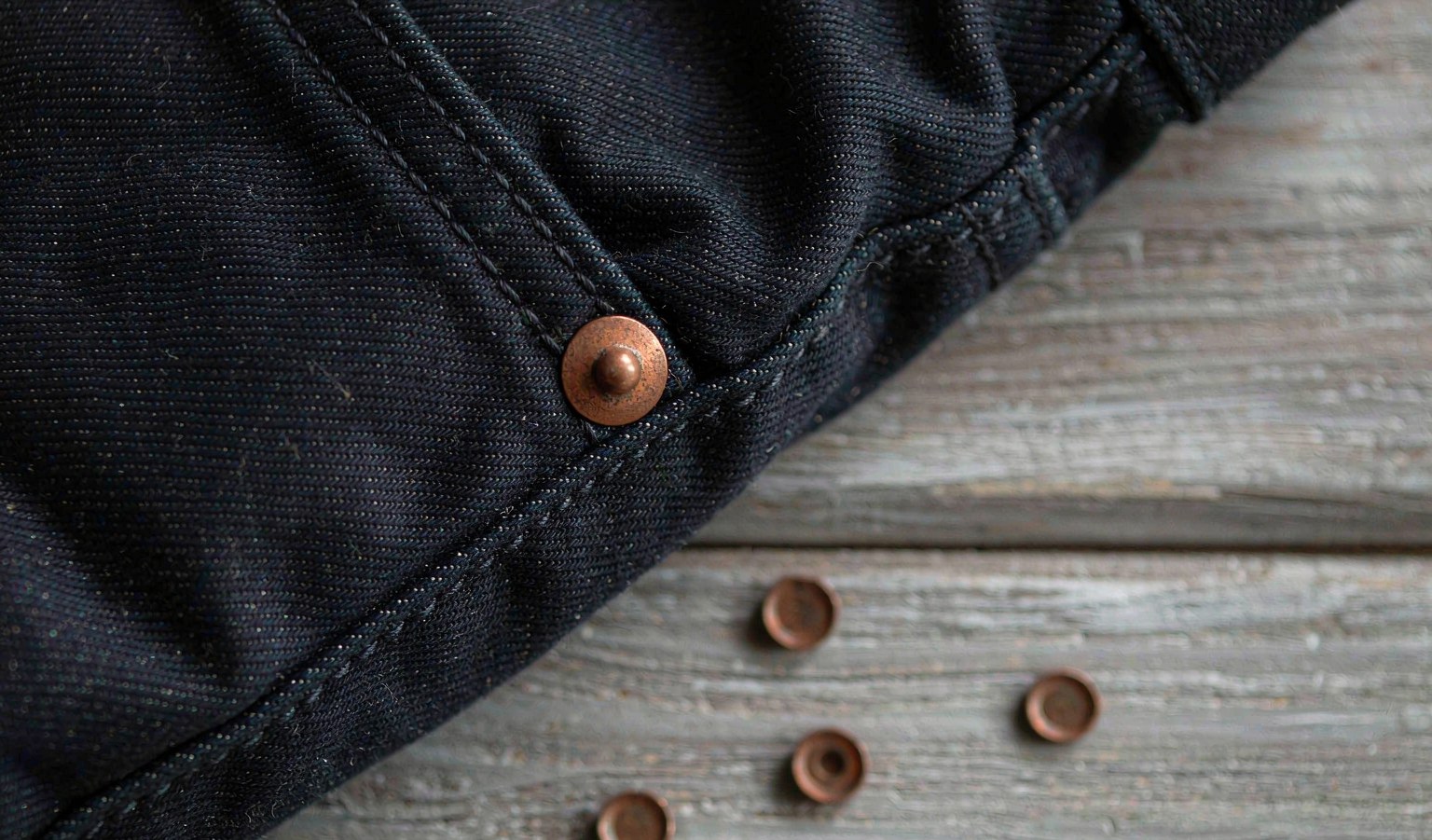
Rivets on Jeans: When the Metal Dots Actually Do a Job
A customer wrote to us last week, half joking, asking whether the metal dots on his new jeans existed to scratch his dining chairs. Fair question. Rivets get blamed for ruined furniture and dented washing machine drums, and some of that blame is earned. But the rivet is one of the few pieces of hardware on a pair of jeans with a real mechanical job, and once you know what it does, you can tell a working rivet from a decorative stud in ten seconds.
The short version: a rivet is a clamp, not a decoration. It holds two layers of denim together at a point where thread keeps losing. The rest of this piece explains why that point is always a pocket corner, where the idea comes from, and how to check rivets before you pay.
The complaint about rivets has a point.
Start with what the critics get right. On many jeans the row of dots is exactly what it looks like: styling. A rivet pressed through a single layer of cloth, with no force passing through it, does no work at all. Decorative studs on the back yoke, along the coin pocket seam where no strain lives, or scattered across the waistband are there to read as heritage. They are also the source of the two complaints everybody knows: a raised dome that scratches the table, and a hard point that hammers the inside of the washing machine drum.
So the criticism is fair for bad rivets. It is not fair for good ones.
What a rivet actually does
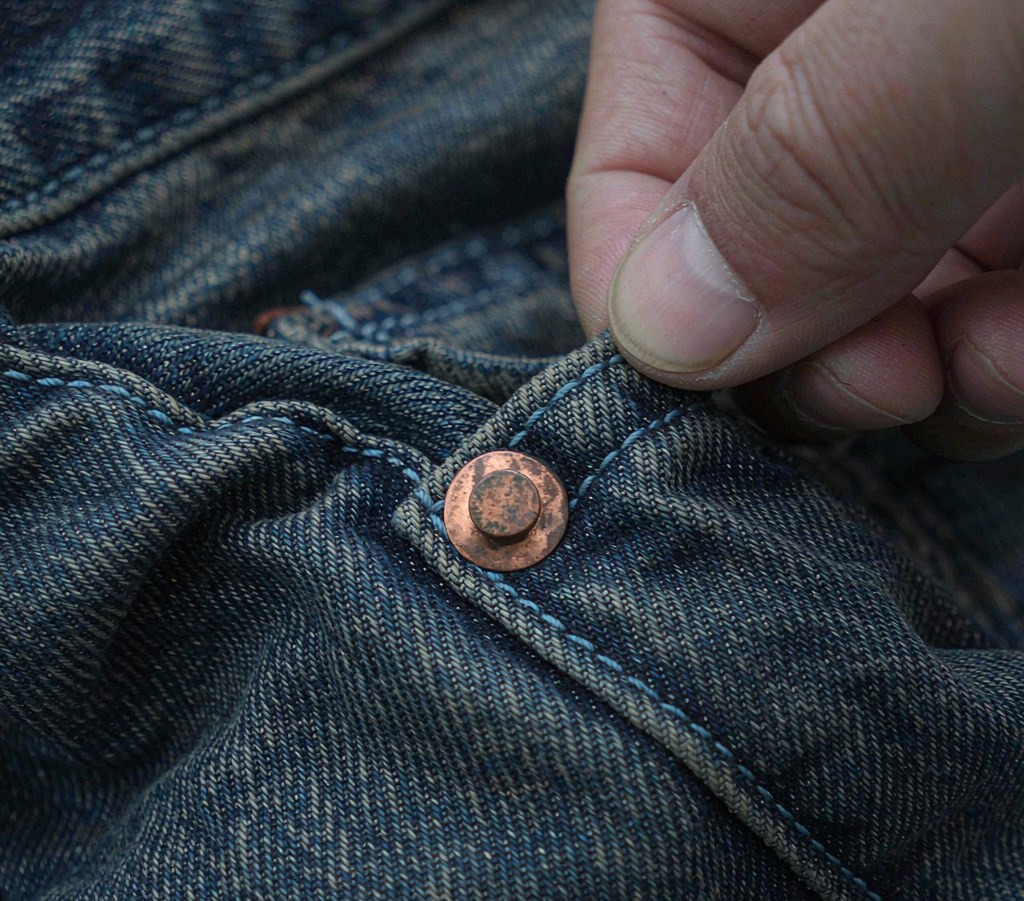
Look at where rivets live on a serious pair: the corners of the front pockets, sometimes the coin pocket, sometimes the top corners of the back pockets. Those corners take a specific punishment. Every time a hand slides in and out, the corner is pulled outward, and the stress concentrates at the sharpest point of the opening.
Thread loses that fight on its own. Stitching holds by loops, and loops sit on the surface of the cloth, where they abrade first. A rivet holds by clamping: a stem passes through the cloth, a burr is pressed over it from the back, and the two layers end up pinched between metal. Nothing to fray, nothing to unpick. On heavy denim, ten ounces and up, that difference is why the pocket corners of riveted jeans outlast the pocket bags themselves.
A patent from 1873 explains the placement.
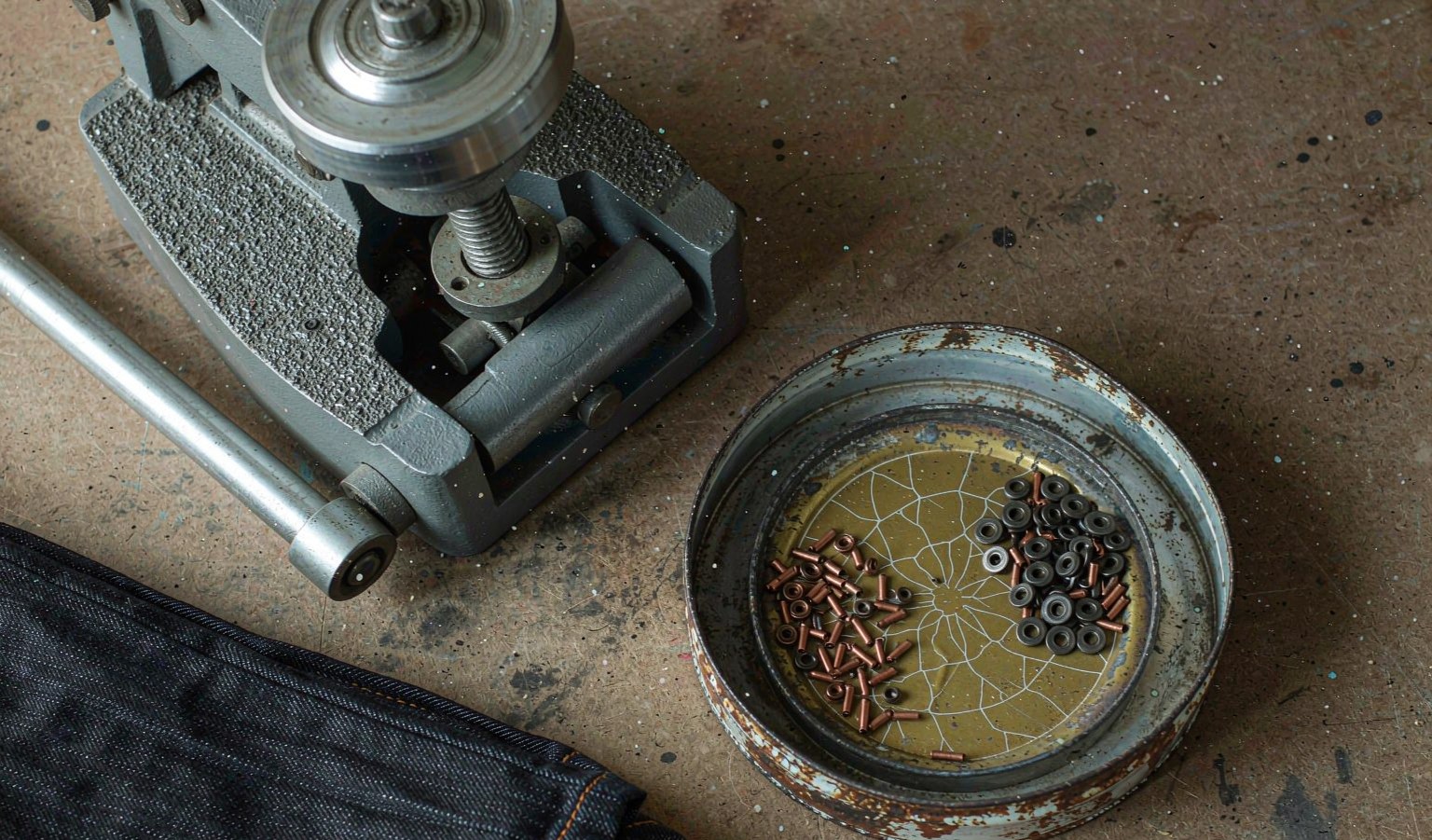
The placement is not fashion instinct; it is the original specification. U.S. Patent 139,121, granted on May 20, 1873 for an improvement in fastening pocket openings, describes exactly this: copper rivets driven through the corners of pocket openings on work trousers, because the tailor who filed it kept seeing pockets tear away before the cloth wore out. A reissue in 1875 stretched the idea to other garments. Every working rivet since then sits where that patent sits: at the corner, through both layers, close to the seam.
That history is also the honest test. If a rivet is not at a stress point and not through both layers, it is quoting the patent without doing the job.
Real jobs versus decoration: where the dots belong
A rivet earns its keep in four places: the two front pocket corners, the coin pocket corners, the top corners of the back pockets, and occasionally a tool loop on work pants. Anything beyond that list deserves suspicion. Rivets down a side seam, across the yoke or on the cuff are styling, and on thin cloth they can even speed up wear by acting as grinding points.
Material matters too. Solid copper and brass rivets set cleanly and age into a patina. Thin plated steel ones can crack the cloth around them or rust and stain the denim brown at the contact point. Cloth weight matters as well: below about eight ounces a rivet has too little to bite into, which is why light summer jeans often skip them.
The twenty-second check before you buy
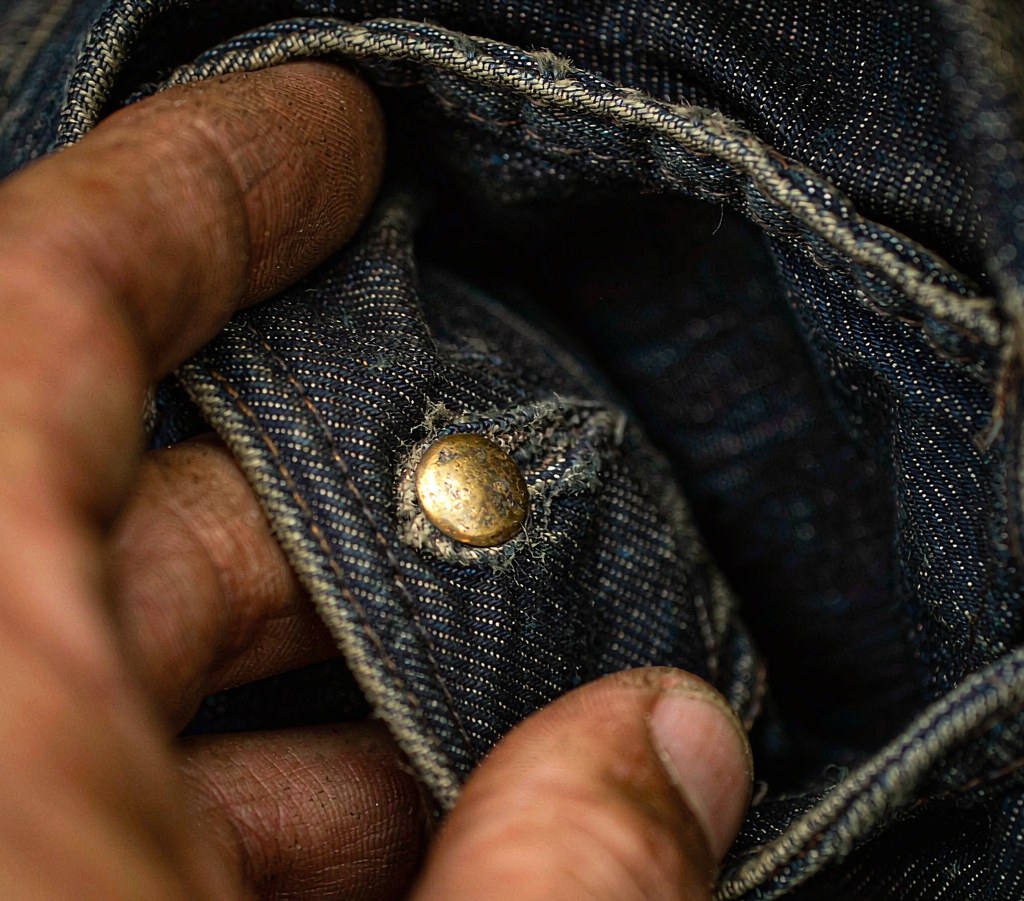
In the shop, run this check. One: look at placement. Corners, both layers, close to the seam, or put the pair down. Two: press the back of a rivet through the pocket bag with a fingertip. A properly set rivet ends in a smooth burr; a rough or raised one will scratch your leg, your chair and the drum. Three: wiggle the head with a fingernail. It should not rock. Four: look at the cloth around the head. Cracked or shiny marks mean the rivet was set too hard.
Rivets age too: drums, chairs and green dust.

Set rivets still ask for one habit: turn jeans inside out before washing. The drum complaint almost always comes from an unturned pair tumbling dome-down. Copper adds its own quirk: with moisture and time it grows a green oxide, the same verdigris you see on old roofs, which brushes off as dust and washes out. If a rivet is ever lost, an alterations shop can set a new one in minutes, and the cloth around the old position stays usable. At BenClothing, we would rather place four rivets where they work than fourteen where they photograph; the white washed retro pair and the gradient washed pair in our range are picked by that rule.
Key takeaways
- A rivet is a clamp: a stem and a burr pinch two layers of denim together at a point where stitching abrades first.
- Riveted pocket corners trace back to U.S. Patent 139,121, granted May 20, 1873 for fastening pocket openings on work trousers.
- Four positions earn a rivet: front pocket corners, coin pocket corners, top back pocket corners, and tool loops.
- A smooth burr on the inside means the rivet was set right; a rough one will scratch furniture and the washer drum.
- Turn jeans inside out before washing, and remember a lost rivet can be re-set in minutes.
FAQ
Why do some jeans have no rivets at all?
Mostly cloth weight and cost. Below roughly eight ounces there is little for a rivet to bite into, and a rivet plus the press to set it adds cost, so light summer jeans and budget pairs often leave them off. Some makers replace them with hidden rivets or extra stitch reinforcements to protect furniture.
Are copper rivets better than steel ones?
For workwear, usually yes. Copper and brass are soft enough to set without cracking the cloth, they do not rust into a brown stain, and they age into a patina. Plated steel is cheaper but can rust and stain the denim around the contact point. The same care logic applies to the zipper, the other piece of hardware you should test by hand.
A rivet is the smallest structural part on a pair of jeans. Place four where the forces actually land and set them smooth, and they quietly do the work that patent described in 1873; scatter them for looks and they are just dots that scratch.