
The Runway Keeps Stealing From the Job Site: Four Workwear Details That Outlive Trends
Quick answer: runways borrow from workwear every season, but only four details keep coming back: pockets placed where hands actually reach, reinforcement where fabric tears first, cuffs and hems you can adjust, and fabric with enough weight to hold a shape. Those four survive because they solve problems on a job site, not because a trend cycle chose them. If you want clothes that still look right in five years, check for those details in the product photos before you look at anything else.
The runway borrows. It rarely invents.
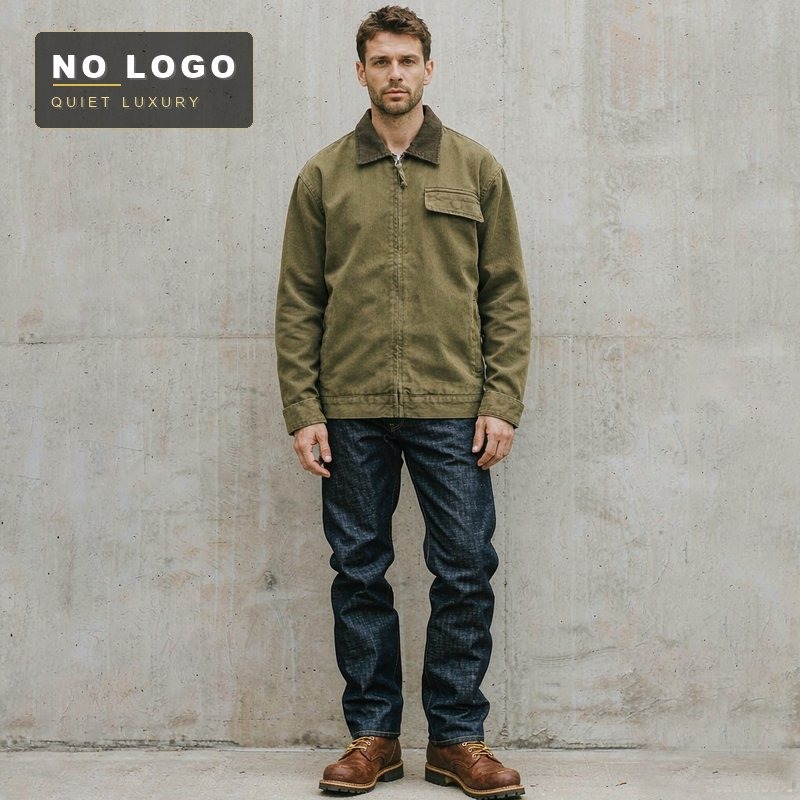
Fashion pulls from uniforms constantly: canvas, utility pockets, boxy cuts, hardware. What it takes is almost always a detail with a job behind it, borrowed from people who were paid to test it. A jacket cut wide through the shoulder came from men who needed to swing an arm. A pocket flap came from something falling out. When a season passes and the runway moves on, the borrowed details stay in the workwear category, because the reason they were designed never left. That is the whole argument for buying workwear instead of buying trends: the design brief was function first, so the shape ages slowly. Our heavy-duty washed work jacket is the kind of piece built on that brief.
Detail one: pockets where hands actually work
Look at where the pockets sit, not how many there are. A chest pocket you can reach with a bent elbow, a hip pocket that clears a belt, a lower cargo pocket positioned slightly forward so a seated wearer can still open it. On cheap versions the pockets exist to fill the photo, so they land wherever the pattern was quickest to draw. Test it like this: put the garment on, and without looking, try to reach each pocket. If you have to hunt, the placement is decoration. Weight matters too. A thin pocket with a thin flap will not hold a tool, a phone and a car key without sagging and pulling the front of the jacket out of line.
Detail two: reinforcement where fabric tears first
Fabric fails at stress points, and every stress point on a garment repeats across every design: pocket mouths, the base of a placket, belt loops, the point where a strap meets a seam, the inside corner of a cargo pocket. Workwear answers with extra stitches, a bar tack, a folded reinforcing strip, or a second layer of cloth behind the opening. None of it shows in a product photo unless you look for it, and that is exactly why it is the first thing to disappear when a factory cuts cost. When you inspect a jacket in person, pull the pocket mouth gently apart. You should feel resistance and see a dense short stitch sitting across the corner rather than a single line running out into the fabric.

Detail three: cuffs and hems you can adjust
A fixed cuff fits one wrist and one season. An adjustable one belongs to whoever wears it: snap tabs, a short strap, an elasticated inner cuff that keeps wind out while the outer cuff stays straight. The same logic applies at the hem, where a drawcord or a tab lets you change the length and the drape without a tailor. This is the one borrowed detail that most cheap copies either skip or fake with a decorative strap that carries no tension. Check that the adjuster actually changes the fit when you pull it. A tab that moves without tightening anything is a costume part.
Detail four: fabric with enough weight to hold a shape
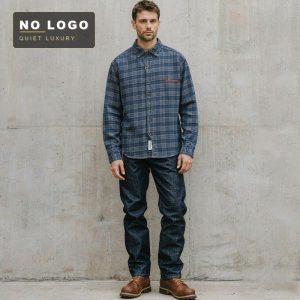
Light fabric wrinkles, collapses at the shoulder and shows every belt line. Heavier cloth hangs from the shoulder in a straight fall and keeps the line of the garment even after a day of wear. That is why workwear reads as deliberate rather than sloppy, and why a plaid denim shirt-jacket in a denser weave can carry an outfit that a thin overshirt would flatten. Heavier fabric is also the honest option: it takes longer to wear out, it survives repeat washing, and it keeps a collar standing instead of curling. Buy one heavier piece instead of two light ones and you will get more wears out of both the garment and your budget.
How to check all of this from a product photo
You cannot touch the fabric through a screen, but the details are visible if you know where to zoom. Look for a clear shot of the pocket corner, a photo of the cuff adjuster, a close-up of the placket, and a flat-lay that shows the hem width. A seller who photographs the stress points is usually a seller who specified them. If every photo is a full-body shot from one angle, the details were not a priority. Our fleece-lined patchwork denim jacket and the heavyweight washed denim shirt on this page both have detail shots for that reason, and you can compare the stitching density between them.
Key takeaways
- Runways borrow the four details that solve job-site problems; the reasons outlast the trend cycle.
- Reach every pocket without looking. If you have to hunt, the placement is decoration.
- Pull the pocket mouth apart: you want a dense bar tack across the corner, not one thin line.
- An adjuster must actually change the fit; a decorative tab is a costume part.
- One heavier piece outlasts two light ones and keeps its shape after a day of wear.
FAQ
Does heavier fabric mean hotter fabric?
Not automatically. Weave and fibre matter as much as weight: a dense cotton twill breathes differently from a coated shell of the same weight. Weight decides how the garment hangs and how long it lasts; weave and fibre decide how it feels against the skin. If you run warm, choose a heavier piece in a plain weave and leave the back without lining.
Are cargo pockets practical or just styling?
Both, depending on placement and construction. A cargo pocket with a proper flap, a reinforced mouth and a position you can reach while seated is practical. The same pocket shape sewn flat against the thigh with no bar tack is styling. The cut is identical in a photo, which is why you check the reinforcement and the reach, not the pleat.
The short version
Four details carry workwear through every trend cycle: reachable pockets, reinforcement at the stress points, adjustable cuffs and hems, and fabric with enough weight to hold its line. None of them are expensive to specify, and all of them are easy to skip. Check them first, and the wardrobe you build will still make sense long after this season’s runway goes quiet.