

Cargo pocket engineering: the details that decide whether your wholesale batch survives the first wash
A cargo pocket fails at three points: the bar tacks that hold the corners, the stitch density along the side seams, and the fabric weight behind the pocket itself. Check those three things before you confirm any wholesale order, and you avoid the two most common buyer complaints — pockets that sag after washing and corners that split under load. We sew cargos every day at our workshop in Shishi, so this article walks you through exactly what we inspect on every production run.
\n\n
The three weak points, and how we reinforce them
\n
The side seams of a cargo pocket carry most of the load, and they are where most repairs start. We run two rows of stitching at 10 to 12 stitches per inch along the sides, then add bar tacks at the top and bottom corners. A bar tack is a dense cluster of stitches packed into one spot — it costs almost nothing per unit, and it is the most cost-effective upgrade you can request on any cargo program. The third weak point is the fabric behind the pocket. On our washed cotton cargo shorts with 3D pocket detail, the pocket bag uses the same weight as the body. On lighter shell fabrics we switch to a reinforced twill pocket bag, so the lining never tears away from the shell.
\n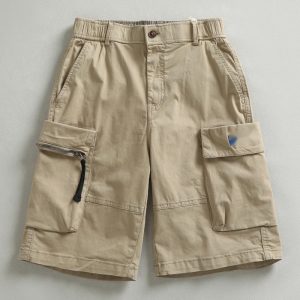 \n\n
\n\n
Flap design and hardware are part of the cost math
\n
A flap keeps dust and phone weight contained, but it adds a cutting piece and a snap operation to every pocket. For US streetwear buyers we usually set exposed metal snaps; for European workwear programs, a hidden snap under the flap keeps the silhouette clean. Neither is better — it depends on what your customer reaches for. What matters at inspection is that every snap is set with a press machine, not hand-hammered, so the pull force stays consistent across the batch. You can see how snap-flap pockets work in practice on our M65 field denim jacket, where four flap pockets carry the military look without adding bulk.
\n \n\n
\n\n
What to check in your pre-production sample
\n
Before we cut bulk, we make a salesman sample and put it through a pull test on the bar tacks and a domestic wash cycle. Our final inspection runs at AQL 2.5, which means pockets get opened, filled, and re-checked on a defined sample size — not just looked at on a hanger. If you are comparing two suppliers, ask them one question: how do you test a cargo pocket? A factory with a real answer has built cargos before. A vague answer usually means the pockets were sewn by whoever was free that day. The multi-pocket military-style pants in our catalogue show what a finished eight-pocket layout looks like once these checks are in place.
\n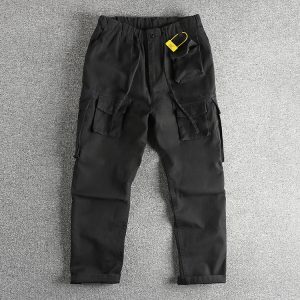 \n\n
\n\n
FAQ
\n
Can we change the pocket layout or add our own hardware?
\n
Yes. Pocket count, flap style, and custom logo snaps or rivets are standard OEM work at our Shishi factory. Send a tech pack, or even just a reference photo, and we will quote a sample with the layout changed. Small runs are fine — our MOQ starts low enough for first orders.
\n
How many pockets should a commercial cargo pant have?
\n
Six is the mainstream count: two hand pockets, two back pockets, and two large side cargo pockets. Going beyond eight raises fabric cost and sewing time faster than it raises the retail price your end customer will accept.
\n\n
Key takeaways
\n
- \n
- Bar tacks at the pocket corners cost almost nothing per unit and prevent the most common split failure on cargo pants.
- Side seams should carry two rows of stitching at 10 to 12 stitches per inch — this is our standard on every cargo style.
- On light shell fabrics the pocket bag must be a heavier twill; on 350g washed cotton the body fabric is strong enough.
- Final inspection at AQL 2.5 means cargo pockets are opened and filled during the check, not just viewed on a hanger.
- Pocket layout, flap style, and logo hardware are all OEM options, and MOQ starts low for first orders.
\n
\n
\n
\n
\n
\n\n
Strong cargo pockets come from boring, repeatable details: bar tacks, dense side seams, and a pocket bag that matches the shell. Check those in your pre-production sample and the batch will outlast the season. Contact us for wholesale pricing.
\n